What Is VO2 Max, and How Much Can You Improve It?
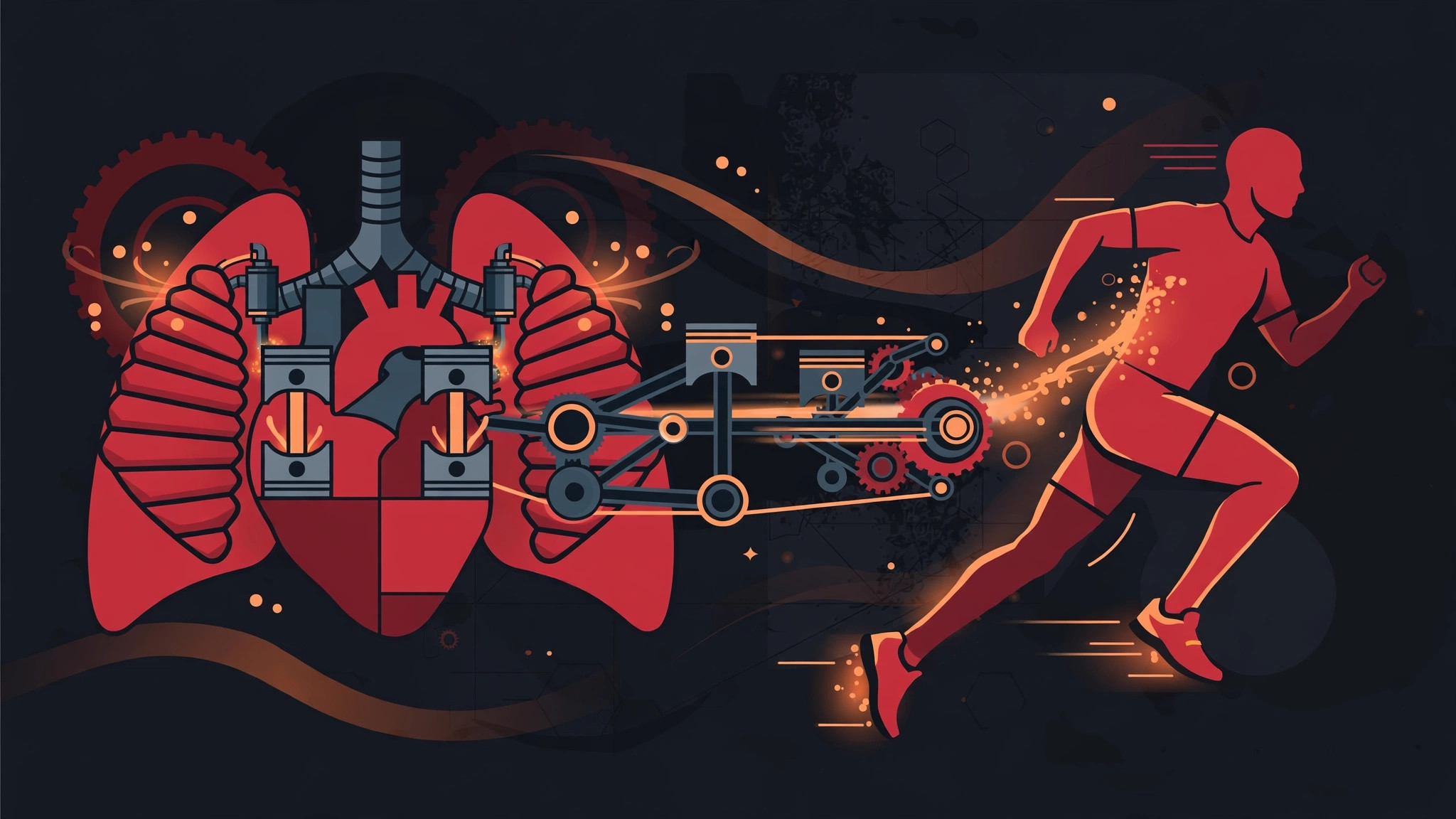
The ceiling of the engine
VO2 max is the fastest rate at which your body can take in and use oxygen during hard exercise, measured in millilitres per kilogram per minute. It sets the ceiling for endurance: the bigger the engine, the faster the pace you can sustain aerobically. Elite endurance athletes reach the 70s and 80s. Healthy untrained adults typically sit between 30 and 45, and values climb with training and fall with age and inactivity. A useful comparison hides in everyday life: climbing stairs briskly demands roughly 20 to 25 ml per kg per minute, so someone with a VO2 max of 30 is working near their ceiling on the stairs, while someone at 50 strolls up at half effort. This is why raising VO2 max feels less like sport and more like the whole day getting easier. The number is athletic and domestic at once.
Genetics loads it, training moves it
Roughly half the variation between people is inherited: heart size, blood volume and muscle fibre mix all run in families. The trainable half is still generous. Beginners routinely improve VO2 max by 15 to 20 percent within months, because almost any consistent training works at first. Later, gains come from structured intensity: intervals near maximum are the strongest stimulus, supported by a large base of easy volume. Age grading puts your score in fair context. A VO2 max of 42 is modest at 25 and excellent at 65, because the measure falls with age even in the trained. Many calculators and race tables offer age graded comparisons for this reason. Judge yourself against your decade and your own history, not against a 22 year old professional's physiology.
Testing without a laboratory
Laboratory tests use a mask and a treadmill ramp to exhaustion. Field tests trade a little accuracy for a lot of practicality: the Cooper 12 minute run and the Rockport one mile walk both estimate VO2 max within a few points for most people, and our VO2 max calculator runs both. Whatever the method, compare like with like over time; the trend is your training report card. Beware the watch estimate's confidence. Wrist devices infer VO2 max from pace and heart rate relationships and can be several points adrift, especially in heat, hills or early training. Use the watch figure as a trend line, and anchor it occasionally with a proper field test like the Cooper or Rockport protocols, run under similar conditions each time.